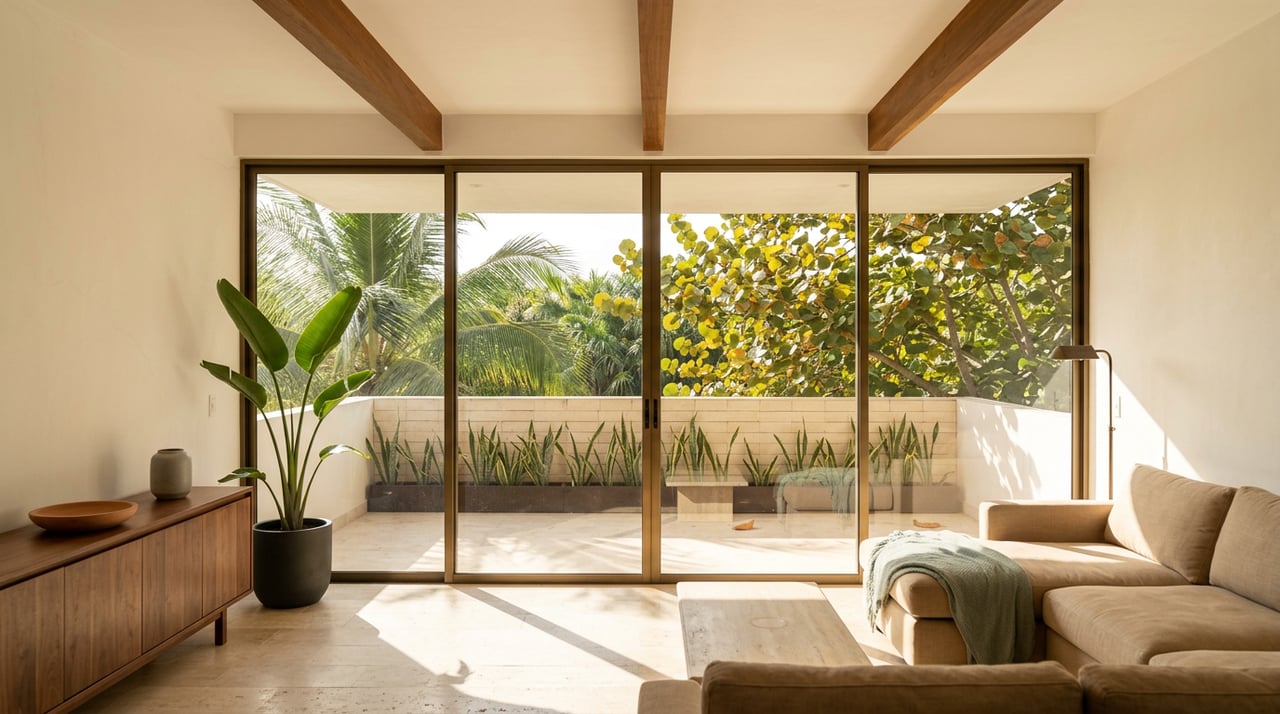
Two Doradosbuyers Never See Until They're Under Contract: The Resort Gate as a Market Boundary
August 6, 2026
August 6, 2026
The cleanest tell in Dorado's 2026 market is a single number that sounds like good news for buyers and isn't. Across verified closed luxury sales inside the resort corridor in the first half of the year, buyers negotiated an average of roughly 11% off the original asking price. Read that as leverage and you'll misprice your offer. Read it as the discipline of a market where sellers now price to draw traffic, then hold firm against comps, and you'll understand why a $2.5M budget behaves like two entirely different budgets depending on which side of the guardhouse you're standing on.
Most guides treat Dorado as one market with a luxury tier on top. That framing hides the mechanism. The gate at Dorado Beach isn't a lifestyle boundary. It's a supply boundary, a buyer-pool boundary, and, starting December 31, a tax-status boundary. Everything the median-per-square-foot doesn't tell you lives in that gap.
The Dorado Beach resort corridor holds roughly 1,100 residential units across the Ritz-Carlton Reserve residences, Dorado Beach East, West Beach, The Isles, Legacy, Plantation Village, Fairways Villas, The Greens, and Dorado Country Estates. That count is essentially fixed. The resort is bordered by the Atlantic, existing resort infrastructure, and protected land, and no new beachfront parcels are being created. In the first half of 2026, median price per square foot inside that corridor reached about $820, up roughly 14% year over year.
Outside the gate, the same municipality behaves like a different market. Recent snapshots for the 00646 area show median listing bands in the $2.2M–$2.4M range and roughly 100–110 days on market, with a wide dispersion because the pool includes Sabanera Dorado, La Cala, and a variety of non-resort urbanizaciones alongside occasional resort-adjacent listings. Sabanera Dorado's own June 2026 closed sales ran from about $1.2M to $2.65M, with luxury long-term rentals reaching roughly $18,500 per month. Same municipality, different physics.
The other structural feature worth naming: roughly 40% of luxury transactions in the top Dorado communities occur off-market, according to Q1 2026 Stellar MLS-based reporting. A buyer working exclusively from public portals is seeing a filtered slice of what's actually trading.
The reason "median price" is a poor decision tool in Dorado is that $2.5M is either an entry-level ticket or a top-of-market ticket depending on which side of the gate you point it at. A compact comparison, using H1 2026 closed-sale ranges and reported inventory:
| Where the money goes | Inside the resort gates | In the surrounding municipality |
|---|---|---|
| What $2.5M typically buys | An entry-tier condo or smaller villa in Fairways, The Greens, or Plantation Village; below the most active resort band | A well-positioned single-family home in Sabanera Dorado or La Cala, often near the top of that community's range |
| Most active price band, H1 2026 | Roughly $3.5M–$6.5M across the resort enclaves | Roughly $1.2M–$2.65M in Sabanera Dorado closed sales |
| Ceiling markers, recent | Verified H1 2026 closings at $8.1M, $9.5M, $11.6M, $12M, and $13M; prior trophy sales including a Dorado Beach Estates villa reported around $20M in late 2024 | Rare; ceiling-setting sales in the surrounding communities are the exception, not the pattern |
| Buyer pool | Cash-heavy, relocation-driven, Act 60-motivated, often U.S. mainland-based | Mixed: relocating families, local move-up buyers, professionals prioritizing schools and daily livability |
| Days on market posture | Well-priced Reserve-branded product can trade quickly; estates run longer with multi-stage inspections | Broader municipal figures around 100–110 days; well-priced, well-presented homes move faster |
| Total cost of ownership | Meaningful HOA, club initiation, dues, and resort membership charges that materially shift the carrying cost | Conventional HOA structures where applicable; no resort membership layer |
| Inventory visibility | An estimated 40% of luxury transactions closed off-market | Predominantly on-market through MLS |
The takeaway isn't that one side is better. It's that the two sides answer different questions. Inside the gate, the question is "which enclave, which building, which in-building comp." Outside, the question is "which community anchors the daily life you actually want, and what does that home need to justify its price against a slower-turning pool."
The single most consequential fact for anyone transacting in Dorado in the back half of 2026 is a legislative one. A 4% tax on passive investment income applies to new Act 60 Resident Investor decree applicants after December 31, 2026. That change effectively creates a two-tier system between decrees filed before year-end and decrees filed after, and it has accelerated the timelines of buyers who had been evaluating Puerto Rico for the last twelve to eighteen months without moving to contract.
That deadline doesn't push evenly on both sides of the gate. It pushes on the inventory Act 60 buyers actually want: primary residences inside the resort corridor and select comparable homes in Guaynabo and Condado. For sellers who own the right product in the right enclave, the second half of 2026 is a specific and time-limited window in which motivated, well-capitalized buyers are more willing to close near ask on well-positioned properties. Once the deadline passes, that specific tailwind ends.
Read the 11% average discount off original ask alongside the December 31 deadline and a clearer picture appears: sellers who priced ambitiously in early 2026 are meeting the market on the way down, while sellers who priced against recent in-building comps are holding closer to ask as urgency builds. Averages hide that split.
Outside the gate, the deadline is a background variable, not a driver. Sabanera Dorado, La Cala, and the broader municipal market answer to relocating families, TASIS Dorado-adjacent demand, and local move-up buyers whose timelines aren't tied to a decree filing. That's the segment where buyer discipline still pays.
Transaction friction in Dorado is enclave-specific. If you're buying, the following show up in the closing file more often than a first-time Puerto Rico buyer expects:
None of this is exotic. It's the specific texture of transacting inside a small, gated micro-market where a handful of sales can move the reported average and where the buyer pool skews toward cash, speed, and confidentiality.
If the median inside the gate is up 14% and buyers are still averaging 11% off ask, which signal is right? Both. Sellers are pricing against a rising market and buyers are enforcing discipline against actual comps. The homes that transact at or near ask are the ones priced against recent in-building sales from the start. The 11% average is concentrated in listings that opened above where comps supported.
Does the December 31 Act 60 change affect existing decree holders? The 4% passive-income tax applies to new Resident Investor decree applicants after that date. Anyone whose motivation depends on the tax profile of a new filing should be working with qualified Puerto Rico tax counsel now, not in December.
Is Sabanera Dorado a fallback for buyers priced out of the resort? It's a different product, not a discount version of the same one. Sabanera answers to a family-oriented buyer with different priorities around daily livability, proximity to TASIS Dorado, and long-term residence rather than resort amenity access. Underwriting it as "Dorado Beach minus" is the wrong frame.
If you're weighing a purchase or a sale in Dorado this fall, the version of this market you see depends entirely on which comps, which enclaves, and which off-market conversations you're inside of. Verónica Vélez works both sides of the gate and can help you calibrate a strategy to the right one for your timeline. Let's connect.
Stay up to date on the latest real estate trends.
Whether you're relocating from the mainland, investing in Puerto Rico, or preparing to sell your current home, Veronica takes the time to understand your goals and create a tailored plan that fits your unique needs. Her background in marketing, sales, and interior design allows her to offer a well-rounded perspective that goes beyond the transaction. From your first conversation to well after closing day, Veronica is committed to building lasting relationships and being a trusted resource for every stage of your real estate journey.
(939) 313-2027
[email protected]
425 PUERTO RICO 693 STE 693
DORADO, PR 00646